
What is Performance Marketing? Definition, Examples, Benefits


Learn what performance marketing is, how it works, top examples, and why it’s a must-know strategy for advertisers aiming to maximize ROI.
What is performance marketing? It’s a results-driven digital marketing approach where advertisers only pay when specific actions are achieved (like a click, lead, or sale). In simple terms, you spend money only on measurable outcomes – if the campaign doesn’t deliver, you don’t pay. This model matters because it ensures every marketing dollar is tied to real results and return on investment (ROI). In fact, according to Statista, global digital ad spending is projected to exceed 600 billion by 2027, reflecting how businesses are embracing measurable marketing. Performance marketing helps even small advertisers cut waste and focus on what works, making it an essential strategy in today’s ROI-focused world.
How Performance Marketing Works
Performance marketing works by constantly measuring and optimizing campaigns based on data. Marketers set a desired outcome (for example, an online sale or a sign-up) and choose platforms or partners to run ads. They then pay only when that outcome happens. For instance, on Google or Facebook, you might start with a small budget across many ads, then shift spending to the top-performers driving actual sales. If one ad or keyword brings more conversions, you funnel more money into it and pause the weaker ones. This way, the campaign “learns” and improves over time.
Behind the scenes, there are a few key players in performance marketing:
- The advertiser (or retailer) who wants to promote a product or service. They define the goals (e.g., a purchase or lead) and set the reward or payment for each result.
- The publisher or partner (such as an affiliate website, influencer, or ad network) who displays the ads or promotions to the audience. They get paid only when they deliver a result (for example, a commission for each sale they generate).
- The platform or tracking network that links the two and tracks every click, sign-up, and sale. This technology ensures each action is credited to the right source so that payments are accurate.
Because everything is tracked in real time, performance marketing is very data-driven. Advertisers constantly monitor metrics like clicks, conversion rates, and cost per conversion. If an ad isn’t performing, they can tweak the content, adjust the targeting, or try a different channel almost immediately. Essentially, performance marketing is a cycle of testing, measuring, and optimizing. The result is a highly flexible approach – you can scale up campaigns that work and quickly fix or cut those that don’t, all based on hard numbers.
Examples of Performance Marketing Channels
Performance marketing isn’t limited to one platform – it spans many digital advertising channels. Here are a few common examples:
- PPC (Pay-Per-Click) Ads: Run ads on Google or social media and pay only when someone clicks. Great for quick traffic and testing what works.
- Affiliate Marketing: Partners promote your offer using special links. You pay a commission only when they bring a sale or lead — ideal for low-risk growth.
- Influencer Marketing (Performance-Based): Many influencers now get paid based on how many sales or sign-ups they drive using trackable promo codes or links.
- Programmatic Advertising: AI-powered platforms automatically place your ads in front of the right people. You choose your goal — like clicks or conversions — and the system optimizes for results.
These are just a few examples of performance marketing channels. Others include email marketing (where you might pay per email lead or conversion), and native advertising (sponsored content that blends into websites, often bought on a per-click or per-action basis). The common thread is accountability – in all these channels, spending is tied to clear results.
Performance marketing is popular for one simple reason: you get results you can track, improve, and scale. Here’s why it works in 2025:
- You Only Pay for Results: Whether it’s a click, lead, or sale, you’re not spending on guesses. Every dollar goes toward a real outcome, making your budget work harder.
- Real-Time Tracking = Smarter Decisions: You can instantly see what’s working. Metrics like ROI, CPA, and ROAS help you adjust fast and drop what’s not performing.
- High ROI, Even on Small Budgets: Start with $50, scale to $5,000. Since campaigns are goal-driven, even small businesses can grow fast without overspending. No wonder 70% of marketers increased performance budgets in 2025.
- Precise Targeting: Show your ads to the right people, at the right time. Target shoppers by behavior, interests, or actions — boosting your conversion rate and cutting wasted impressions.
- Easy to Optimize & Scale: A/B test ads, switch up creatives, and tweak your funnel based on real data. Over time, small wins add up and great campaigns become revenue engines.
Performance marketing is all about efficiency and accountability. You invest in campaigns that clearly contribute to your goals (sales, leads, etc.). For businesses looking to maximize their marketing budget and measure success at every step, these benefits make performance marketing extremely attractive.
Common Performance Marketing Models (CPA, CPL, CPM, CPS)
In performance marketing, several payment models are used to define how you pay for results. Here are some of the most common models explained:
- CPA (Cost Per Acquisition):
You pay when someone completes a valuable action — like buying, signing up, or downloading. Example: $10 per customer. It’s flexible, low-risk, and widely used in ecommerce. - CPL (Cost Per Lead):
A type of CPA focused on collecting leads (like email signups or quote requests). Great for service industries or B2B. You only pay for valid leads, not just traffic. - CPM (Cost Per Mille):
You pay for every 1,000 ad views. CPM is about visibility, not action, so it’s often used at the top of the funnel. Works best when paired with smart targeting. - CPS (Cost Per Sale):
You pay only when a sale is made — perfect for affiliate programs. For example, give a 10% commission per sale. No sales = no spend. Win-win for advertisers and partners. - CPC (Cost Per Click): (Bonus)
You’re charged each time someone clicks your ad. Common in PPC campaigns (like Google or Meta Ads). It drives traffic, but you’ll still need to convert that traffic into results.
In practice, performance marketing campaigns may involve multiple models. For example, you might pay affiliates on a CPS basis, run Google Ads on a CPC basis, and buy some banner ads on a CPM basis – all concurrently. The key is that you choose the model that best aligns cost with your end goal. If you want sales, CPS/CPA models are ideal. If you want web traffic to feed your funnel, CPC could be the focus. Understanding these acronyms helps you set up campaigns and partnerships with the right expectations on both sides.
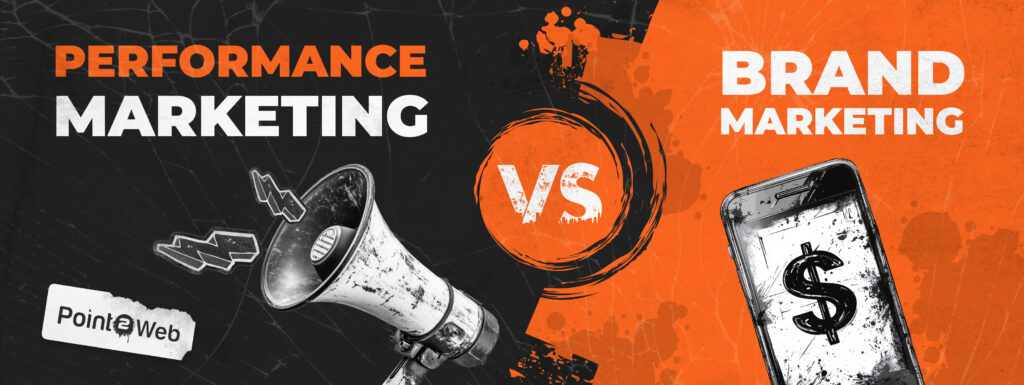
It’s important to understand that performance marketing and brand marketing are not the same, though they complement each other. In short, performance marketing focuses on immediate, measurable results, while brand marketing focuses on long-term reputation and awareness. Here’s a side-by-side comparison to help you see the full picture:
| Feature | Performance Marketing | Brand Marketing |
| Main Goal | Drive immediate actions (clicks, leads, sales) | Build awareness, trust, and long-term loyalty |
| Timeframe | Short-term (daily/weekly results) | Long-term (months/years to build momentum) |
| Payment Model | Pay-per-click (PPC), per lead (CPL), or per sale (CPS/CPA) | Often paid upfront (fixed sponsorships, creative production, etc.) |
| Key Metrics (KPIs) | ROI, ROAS, CPA, CTR, conversion rate | Brand recall, reach, sentiment, engagement |
| Tracking & Attribution | Easy to track and optimize in real time | Harder to measure direct results |
| Tools & Channels | Google Ads, Meta Ads, affiliate marketing, programmatic, influencer (CPS-based) | TV, radio, print, storytelling campaigns, sponsorships, organic social content |
| 2025 Trend | 71% of brands increased performance marketing investment for short-term growth | 63% of CMOs say branding is key to sustaining market share in 2025 |
| ROI Potential | High when optimized — campaigns are scaled based on direct outcomes | Branding lifts performance ROI by up to 100% when integrated well |
| Best For | Acquiring customers fast, testing offers, scaling campaigns efficiently | Establishing brand identity, emotional connection, premium positioning |
| Risk Level | Low – you pay only when results happen | Higher – returns are delayed and harder to measure |
In summary: performance marketing vs. brand marketing isn’t an “either/or” battle – it’s a partnership. Performance marketing brings the gears and levers you can pull for quick growth, and brand marketing is the engine oil that keeps the machine running smoothly over time (to use a metaphor).
FAQ
Q1: How do I start a performance marketing campaign?
A: Start by picking one clear goal — like purchases, leads, or app installs. Choose a channel (Google Ads, Facebook, etc.), set a small budget, and make sure you have tracking set up. Test a few campaigns, see what performs best, and optimize from there. Start small, track everything, and scale what works.
Q2: What are some examples of performance marketing campaigns?
A: A few beginner-friendly examples: (1) Launching a Google Search Ad – you bid on keywords and pay per click, only paying when someone clicks through to your site. (2) Running a Facebook/Instagram ad with a conversion goal – you set the campaign objective to “Conversions” and Facebook’s algorithm shows your ad to people likely to buy or sign up; you pay per result (like per purchase). (3) Working with an affiliate blogger – you give a partner a unique referral link and they write an article promoting your product; you pay them a commission only when their link generates a sale.
Q3: How is performance marketing different from digital marketing in general or brand marketing?
A: Digital marketing covers all online tactics. Performance marketing is a part of it that’s fully focused on paying for results (like clicks or sales). In contrast, brand marketing is about long-term trust and awareness, not immediate conversions. Performance gets fast ROI; brand builds loyalty over time. The best strategies combine both.
Q4: How can I scale my affiliate marketing efforts in performance marketing?
A: Focus on two things:
- Expand traffic sources – add new partners like YouTubers, coupon sites, or ad campaigns.
- Optimize top performers – boost commissions, improve creatives, and support underperformers.
Also, improve your conversion rate — better results mean better ROI for both you and your affiliates. Keep tracking what works and scale what delivers.
Conclusion
Performance marketing is a powerful, pay-for-results approach that offers a straightforward proposition – you get what you pay for, and you pay for what you get. For beginners, it provides a clear path: start with a defined goal, run small measurable campaigns, and let the data guide your next steps. We covered how it works, common channels (from PPC ads to affiliate deals), the benefits of its measurability and ROI-focus, and even broke down terms like CPA, CPL, CPM, and CPS. Remember, the beauty of performance marketing is in its accountability. Unlike old-school marketing where half the budget could be wasted unseen, here you’ll know which half is working and you can fix or fuel it in real time.
As you venture into performance marketing, keep in mind the bigger picture too. Performance tactics shine brightest when supported by a strong brand presence and a smart strategy. Use quick-win campaigns to drive growth, but also invest in your brand and customer relationships for sustainable success.
Ready to launch a performance-driven campaign? Contact our experts today [email protected] and boost your growth.
Share this article:


Subscribe Point2Web News and Insights
Related Articles

Who Really Has the Upper Hand: Employers or Talent?
Key HR insights from a candid discussion on the recent Yosa podcast for the Affiliate & AdTech market The question “Who’s in control: em…

5 Mistakes Media Buyers Still Make in 2025 (and How to Fix Them)
Media buying in 2025 isn’t for the faint of heart. Algorithms are tougher, costs are climbing, and users are burning out on ads faster than …

Case Study: Point2Web Helps Honeytoon Drive 2.5x Purchases via Snapchat Ads
To scale quickly and efficiently, Honeytoon partnered with Point2Web, an official Snapchat Business Partner, to launch a full-funnel Snapcha…
Who Really Has the Upper Hand: Employers or Talent?
Key HR insights from a candid discussion on the recent Yosa podcast for the Affiliate & AdTech market The question “Who’s in control: employers or specialists?” sounds simple, but in today’s affiliate and adtech market, it’s anything but. During …
Learn more
5 Mistakes Media Buyers Still Make in 2025 (and How to Fix Them)
Media buying in 2025 isn’t for the faint of heart. Algorithms are tougher, costs are climbing, and users are burning out on ads faster than ever. Yet despite all the changes, many media buyers are still falling into the same costly traps. Let’s break…
Learn more
Case Study: Point2Web Helps Honeytoon Drive 2.5x Purchases via Snapchat Ads
To scale quickly and efficiently, Honeytoon partnered with Point2Web, an official Snapchat Business Partner, to launch a full-funnel Snapchat campaign focused on data, performance, and creativity. The result? Explosive growth in subscriptions and pur…
Learn more
Let’s Take Your Performance Further
From strategic insights to full-scale execution, our team helps you unlock stronger campaigns and sustainable growth. Tell us what you’re aiming for and we’ll help you get there faster.