Top 5 Mobile App Categories Winning in the US in 2026

The US remains the world’s most valuable mobile app market. For app publishers and marketers, it continues to offer unmatched monetization potential, high-spending audiences, and scalable growth opportunities.
Yet scaling in the US has become significantly more challenging. Customer acquisition costs continue to rise, competition across major advertising platforms is intensifying, and user attention is becoming increasingly fragmented. In this environment, growth is no longer determined by who can generate the most installs. The real winners are the companies that combine the right niche, sustainable monetization models, and efficient acquisition strategies.
To better understand which app categories are driving growth in today’s market, we partnered with AppMagic, a market intelligence platform that helps game and app companies conduct market research of any complexity across mobile and PC. Combining AppMagic’s market data with our user acquisition expertise, we analyzed category performance across the US market to identify where revenue growth is happening and what it means for advertisers looking to scale.
Methodology
This analysis is based on AppMagic market intelligence data covering the US mobile app market. We compared category performance between Q4 2025 and Q1 2026, evaluating:
- Downloads
- Revenue
- Revenue per Download (RPD)
- Category-level growth trends
- Leading apps and subcategories
Rather than focusing solely on install volume, we examined how effectively categories convert users into revenue — a metric that increasingly determines long-term scalability.
The New Reality of US App Growth
For years, download volume was often viewed as the primary indicator of growth. Today, however, increasing acquisition costs, intensifying competition, and evolving user expectations have made profitability and monetization efficiency far more important than raw scale.
The data reveals that some of the strongest-performing categories are not necessarily acquiring more users. Instead, they are generating more value from every user they acquire.
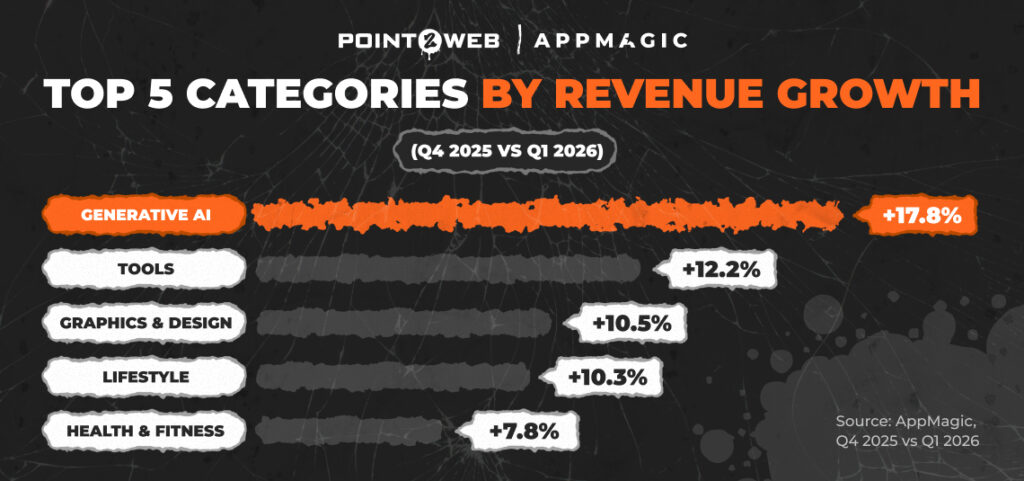
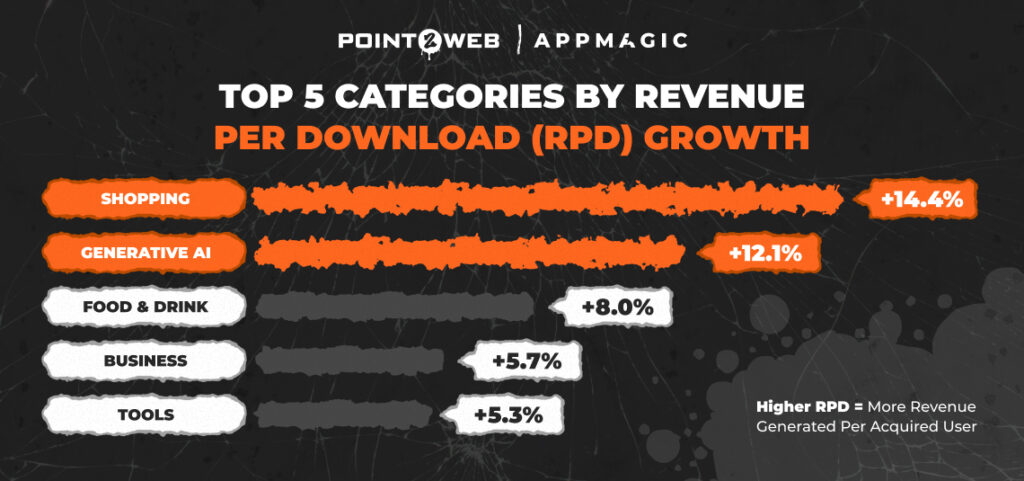
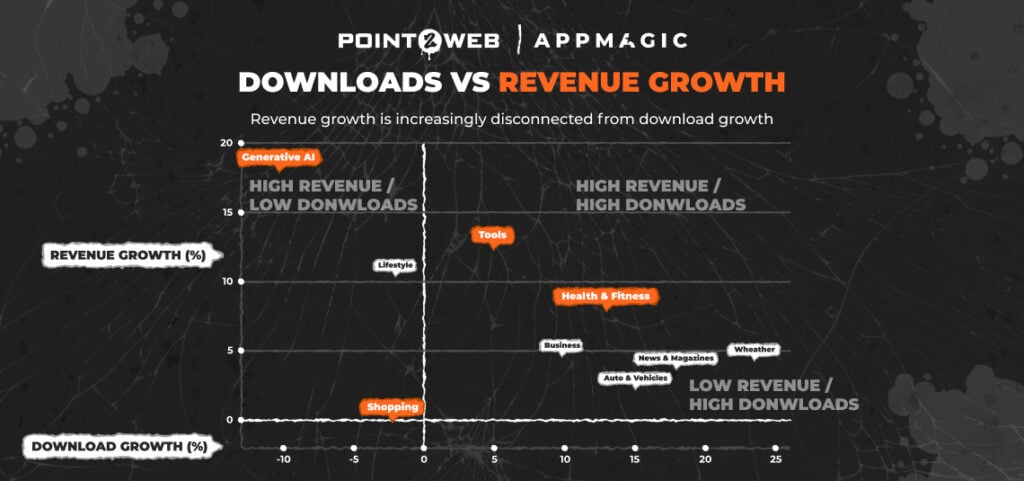
According to AppMagic data, Generative AI is a particularly strong example: despite a 10.3% decline in downloads, category revenue grew by 17.8%, while Revenue per Download (RPD) increased by 12.1%. Similar patterns can be seen across Shopping and Lifestyle, where monetization improvements outpaced user growth.
This trend reflects a broader evolution of the mobile ecosystem. As user acquisition becomes more expensive, app businesses are shifting their focus from maximizing traffic volume to attracting higher-quality users with stronger engagement and purchasing intent. Subscription models, premium features, and long-term retention strategies are increasingly important for sustainable growth.
As a result, metrics such as Revenue per Download (RPD), customer lifetime value (LTV), and retention are becoming more meaningful indicators of category health than download numbers alone. While installs remain important, they are only one piece of a much larger growth equation.
Point2Web Perspective: What These Trends Mean for Advertisers
We work with app advertisers across multiple verticals and acquisition channels, targeting the US market. The trends highlighted in this report closely mirror what we see across successful growth campaigns.
Advertisers achieving the strongest results are increasingly focused on user quality and monetization outcomes rather than install volume alone. They evaluate acquisition efforts not only through cost-per-install metrics, but also through indicators such as Revenue per Download, retention, and long-term customer value.
As competition intensifies and acquisition costs rise, many app companies are also expanding beyond a single traffic source. Combining multiple acquisition channels, ongoing creative optimization, and conversion-focused strategies helps create more sustainable growth while reducing dependence on any one platform.
The takeaway is clear: in today’s US app market, scalable growth comes from acquiring users who generate lasting value, not simply from generating more downloads.
Category #1: Generative AI
Generative AI remains one of the most dynamic sectors in the mobile ecosystem.
While category downloads declined by 10.3%, revenue increased by 17.8%, and Revenue per Download (RPD) grew by 12.1%.
At first glance, declining downloads may appear concerning. However, the opposite is true. The data suggests that Generative AI platforms are becoming more efficient businesses by attracting highly engaged users willing to pay for premium functionality.
AI Chatbots continue to dominate the category, generating 17.8% revenue growth while increasing RPD by 12.4%. At the same time, AI Music Generators emerged as a particularly strong growth segment, with downloads growing 14.4%, revenue increasing 13.5%, and RPD surging by 20%.
The category demonstrates a critical lesson for app marketers: sustainable growth comes from monetization efficiency rather than pure acquisition volume.
From a user acquisition perspective, Generative AI products require audiences with strong purchase intent and clear product-market fit. As competition intensifies across mainstream platforms, advertisers are exploring diversified channel strategies to sustain profitable growth.
Category #2: Health & Fitness
Health & Fitness remains one of the balanced categories in the dataset.
Downloads increased by 13%, revenue grew by 7.8%, and RPD improved by 1.9%.
Unlike categories driven by short-term trends, Health & Fitness benefits from strong recurring engagement and subscription-based monetization models. Users interact with these products regularly, creating opportunities for long-term retention and predictable revenue generation.
The category’s performance suggests continued demand for wellness, weight management, habit-building, and personal improvement solutions.
For advertisers, this creates an environment in which higher acquisition costs can often be justified by stronger lifetime value. As competition for quality users increases, audience targeting and channel diversification become increasingly important to maintaining efficiency at scale.
Category #3: Tools
The Tools category delivered one of the strongest examples of balanced growth.
Downloads increased by 5%, revenue rose by 12.2%, and RPD improved by 5.3%.
The combination of download growth and monetization improvements suggests that users are not only discovering these products but also increasingly willing to pay for premium functionality.
For marketers, Tools represent an attractive category because strong user intent often translates into higher conversion rates and more predictable acquisition economics.
Category #4: Shopping
Shopping delivered one of the most interesting monetization stories in the dataset.
Downloads declined slightly by 2.2%, while revenue remained stable. However, RPD increased by an impressive 14.4% — the highest growth rate among all major categories analyzed.
This suggests that Shopping apps are generating more revenue from each acquired user, despite attracting fewer new users overall.
The category highlights a broader market trend identified throughout this report: sustainable growth is increasingly driven by monetization efficiency and customer value rather than acquisition volume alone.
Category #5: Lifestyle
Lifestyle emerged as another category demonstrating strong monetization fundamentals.
While downloads declined modestly by 2%, revenue increased by 10.3%, and RPD grew by 4.6%.
This performance suggests that users continue to engage deeply with products focused on personal interests, self-improvement, relationships, and daily lifestyle management.
The category’s ability to generate revenue growth despite slightly lower acquisition volume reinforces a recurring theme throughout this report: efficient monetization has become a stronger growth driver than pure install scale.
Why the US Market Remains the Global Benchmark
Despite increasing competition, the US remains one of the most attractive markets for app publishers, thanks to its strong monetization potential and a mature app economy.
At the same time, advertisers face growing challenges:
- Rising CPIs
- Higher CPMs
- Increased competition
- Faster creative fatigue
- Greater pressure on profitability
At the same time, increasing competition is forcing advertisers to rethink how they approach growth and long-term scalability.
The Shift Toward Channel Diversification
The data in this article reveals a clear pattern: the categories generating the strongest results are not necessarily those acquiring the highest volume of users. Instead, they are focused on monetization efficiency, user quality, and long-term value.
For advertisers, this raises an important question: if growth is no longer driven solely by volume, how can app businesses continue to scale profitably in an increasingly competitive market?
One of the strongest trends we observe across high-growth app categories is channel diversification.
As competition intensifies across traditional acquisition platforms, leading advertisers are expanding beyond their core channel mix to access new audiences, improve efficiency, and unlock incremental scale. Native advertising ecosystems, alternative inventory sources, and intent-driven environments are becoming increasingly important components of sustainable growth strategies.
Different categories naturally align with different audience behaviors. Subscription-based products, utility apps, wellness solutions, and AI-powered services often benefit from acquisition environments that support longer consideration cycles and stronger purchase intent.
The result is a more balanced acquisition strategy that reduces dependence on a single platform while creating additional opportunities for profitable growth.
Key Takeaways
The US app market in 2026 is sending a clear message:
- Downloads alone are no longer the most important growth metric.
- Revenue per Download has become a critical indicator of category health.
- Generative AI continues to reshape mobile monetization.
- Health & Fitness remains one of the strongest subscription-driven categories.
- Tools demonstrate balanced, sustainable growth.
- Shopping showcases the growing importance of monetization efficiency.
- Audience quality increasingly outweighs traffic volume.
- Diversified acquisition strategies are becoming essential for scale.
The companies achieving sustainable growth today are not necessarily acquiring the most users. They are acquiring the right users, monetizing them effectively, and building acquisition strategies that extend beyond a single channel.
Looking Ahead
Market intelligence identifies where opportunities exist. Execution determines whether those opportunities translate into growth.
The findings in this report highlight a clear shift in the US app market: revenue quality is becoming more important than user volume, monetization efficiency is increasingly shaping category success, and diversification is emerging as a critical growth strategy.
We help app companies transform market insights into scalable acquisition strategies by combining media planning, user acquisition, creative intelligence, conversion optimization, and access to premium advertising channels. As the US market becomes increasingly competitive, the ability to connect data with execution will become a key differentiator for sustainable growth.
Understanding the Market Is Only the Beginning
Understanding where revenue is growing is only the first step. The real opportunity lies in identifying how your app compares to market leaders and where additional growth can be unlocked through acquisition strategy, monetization optimization, and channel diversification.
Looking to scale your app in the US market?
Using AppMagic’s business intelligence and market data, our team can identify the most effective acquisition channels for your category and build a tailored mix of traffic sources designed to achieve your growth goals.
Whether you’re looking to increase revenue, improve monetization efficiency, or unlock additional scale, we’ll help you determine where your audience is, which channels offer the greatest potential, and how to build a channel strategy that delivers the desired results.
Share this article:


Subscribe Point2Web News and Insights
Related Articles

Affiliate World Europe Budapest 2026: Key Industry Trends and Strategic Takeaways
Affiliate World Budapest 2026: Where Performance Marketing Is Heading Next On July 9–10, Affiliate World Europe in Budapest once again broug…

Q2 2026 Events Recap: Strengthening Global Partnerships and Discovering New Growth Opportunities
Throughout Q2 2026, our team participated in a series of leading international conferences across Europe and Asia, engaging with advertisers…

The Truth About Scaling Performance Campaigns
Scaling performance campaigns requires more than strong creatives or higher budgets. It depends on how well the entire system is built and a…
Affiliate World Europe Budapest 2026: Key Industry Trends and Strategic Takeaways
Affiliate World Budapest 2026: Where Performance Marketing Is Heading Next On July 9–10, Affiliate World Europe in Budapest once again brought together leading advertisers, platforms, agencies, and technology providers to discuss the future of perfor…
Learn more
Q2 2026 Events Recap: Strengthening Global Partnerships and Discovering New Growth Opportunities
Throughout Q2 2026, our team participated in a series of leading international conferences across Europe and Asia, engaging with advertisers, publishers, game studios, technology partners, and platform representatives. Each event provided valuable op…
Learn more
The Truth About Scaling Performance Campaigns
Scaling performance campaigns requires more than strong creatives or higher budgets. It depends on how well the entire system is built and aligned, from traffic sources to funnel mechanics and signal quality. These insights were developed in collabor…
Learn more
Let’s Take Your Performance Further
From strategic insights to full-scale execution, our team helps you unlock stronger campaigns and sustainable growth. Tell us what you’re aiming for and we’ll help you get there faster.